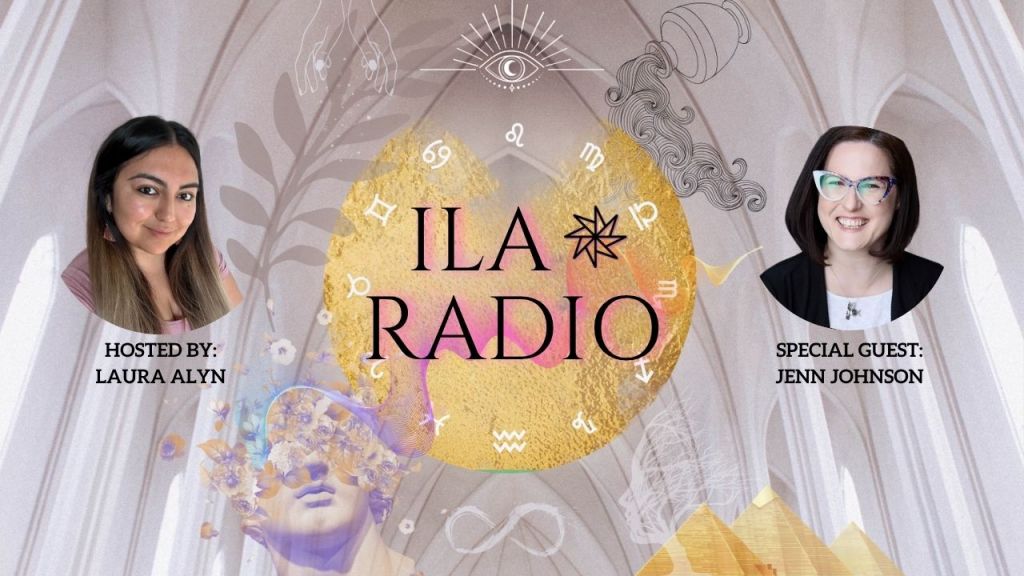
EPISODE 33
What does it really mean to trust your gut—especially in high-stakes environments where every second counts and lives are on the line?
In this episode, ILA Radio welcomes Jenn Johnson, author and critical care nurse, who has spent years navigating life-or-death moments guided by both rigorous training and something less tangible: intuition.
From working with energy in the ER to witnessing the rise of AI, Jenn brings grounded insight, surprising science, and a deep reverence for connecting with the body.
We talk about:
– What intuition actually feels like in real-time
– The two steps anyone can take to begin practicing intuition
– Why it’s time we teach intuition alongside intellect in schools and hospitals
– How AI is being trained to “listen” to the same signs our bodies already know
This episode is for anyone who’s ever felt something before they could explain it, who’s learning to listen more closely to their body, or who’s wondering how the wisdom of the gut might guide us in an age of information overload.
🎧 Listen in and remember:
the body knows—sometimes before the mind can catch up.
For more on Jenn, visit https://www.nursejenn.ca/
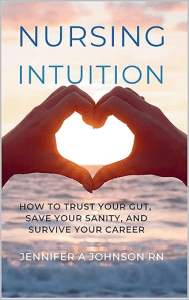
Don’t forget to check out her book!
LISTEN HERE


WATCH HERE

ASTROLOGY SNAPSHOT

MERCURY
ARIES

NEPTUNE
SAGITTARIUS

SUN
ARIES

MOON
ARIES

SATURN
SCORPIO

PLUTO
SCORPIO
Jenn is a bold and instinctive force (Aries Sun, Moon, and Mercury) who moves through life with gut-driven clarity and fearless urgency. She feels first, thinks later—and often turns out to be right. With deep emotional perception and a no-nonsense approach to truth (Saturn and Pluto in Scorpio), she’s built to sense what’s unspoken and act before others even realize there’s a problem. Her visionary edge (Neptune in Sagittarius) allows her to dream big, speak freely, and push boundaries in service of something greater than herself.
Want me to read your chart?
Book personal readings with me here!
HOW DO WE KNOW WHAT WE KNOW?
JJ: “Most of what I know is just by chance. Chance and practice.”
She talks about needing a degree and learning in that sense but that nothing really prepares somebody to encounter the things she does in the ER working with people’s energies mixed with what her gut is telling her.

INTUITION & INTELLECT
LA: “How do you define intuition?”
JJ: “To me intuition is more about ‘how are you feeling?’ because sometimes it is very overt where you have a big stab in your gut where all of a sudden your gut is turning over and you know that something is wrong. It is such a heavy gut punch-kind of feeling that you can’t ignore it. Usually these are life-threatening kind of scenarios.”
JJ: “Other people have senses where they can just feel like something is off, like they are missing part of the story, so now you’re on the alert to look for something.”
JJ: “Ideas will also just pop into my head.”
JJ: “It all depends on the scenario and how you best pick it up and everyone’s a little different.”
JJ: The body will start off small but if you’re not paying attention, it will go to gut punch. “And hopefully she picks it up at that point.”
JJ: Sometimes you will just stop and you don’t know why and it’s a physical stop, my feet won’t let me go any further.
JJ: Intuition is also the hairs on your neck standing up or getting chills.
LA: “How can we develop intuition?”
JJ: There’s usually only two steps.
The first step is just to realize that it’s happening. Give yourself five seconds to process and not immediately brush it off.
The second step is picking your head up and paying attention. And asking yourself, “What needs my attention that I’m not paying attention to?”
JJ: Critical care nurses in fast-pace environments were more accurate with their intuition because they didn’t have time to second guess themselves. https://pmc.ncbi.nlm.nih.gov/articles/PMC4754101/

THOUGHTS ON EDUCATION
LA: How could we do better in education?
JJ: I’d teach intuition. In primary school, in nursing school, everywhere. We tell people to “trust their gut,” but we don’t teach them how. That’s wild to me—because now that I’ve written a book about it, I hear that phrase constantly: on the radio, in books, in random conversations. It’s like the universe is winking, like, we’ve been trying to tell you all along. I think education should include inner knowing, what feels right, and how to listen when something inside you says “pay attention.” That’s where real discernment begins. And if the last five years taught us anything—through COVID and beyond—it’s that the mind alone isn’t enough. We need to honor the wisdom in the gut too.

LEARNING FROM NATURE
JJ: Everything happens for a reason, even the hard, messy stuff. There’s often a long waiting period before you understand why something happened, but eventually, you realize: That’s why I was in that place, with that person, at that time. The story needed it. The ecosystem needed it. Nature doesn’t rush meaning, and neither does life. I think that’s one of the deepest lessons: trust the timing. Even in chaos, something’s unfolding.
LEARNING FROM AI
JJ: Around five years ago, we didn’t think AI was going to be that big of a deal and now I use ChatGPT every single day. That’s the beauty of science. You never know what’s in the works and what’s going to be coming out. Everything changes so quickly.
There are now AI-driven biomarkers!
JJ: There are emerging AI components being developed that actually mirror aspects of intuition. For example, Cedars-Sinai in Los Angeles has a program that scans a patient’s electronic health record—analyzing around 12,000 data points per second—and can alert doctors hours or even a full day before a patient shows visible signs of deterioration. It’s fascinating to see how this kind of technology is now part of the broader conversation, almost like intuition being brought into the group chat.

JOURNAL PROMPTS
1. When was the last time I felt something in my body—before I had words or proof—and it turned out to be right?
2. What does intuition feel like in my body? How do I usually receive it (gut punch, chills, stillness, knowing, etc.)?
3. Do I tend to second-guess myself? What would it take to pause and listen before dismissing my first instinct?
4. Where in my life am I being nudged to pay attention right now?
5. If I were to teach intuition to children or students, what would I say?
6. How did the past few years (e.g., during COVID) shape or sharpen my intuition—or my relationship to trust and uncertainty?
7. What fears tend to cloud my inner knowing? How can I distinguish fear from intuition?
8. How do I feel about AI being used to mimic or support intuition in high-stakes fields like healthcare?
9. What is a lesson from nature I’m still unpacking? What has life taught me about timing and trust?
10. Where in my life right now am I being invited to trust the gut, not just the plan?
ILA INSTITUTE CONNECTION
At ILA Institute, we’re returning to how humans naturally learn—through immersion, intuition, and curiosity—not tests or textbooks.
Our students explore knowledge in parks, museums, languages, and communities, guided by wonder and real-world inquiry.
Whether you excelled, dropped out, or never fit in, ILA is your invitation to learn like you were always meant to.
MORE INFO COMING SOON
Subscribe!
Curious how simply visiting a museum can spark deep learning? Follow us on TikTok to explore how we turn curiosity into knowledge.

ABOUT THE HOST
Laura Alyn is an educator, intuitive PhD researcher, astrologer, spiritual practitioner, and founder of the ILA Institute. She blends spiritual insight with academic curiosity to build new pathways of knowing—for individuals and for the future of education. To learn more about her, click on her below or click here.

More to Trust In:
More from the Host


Something went wrong. Please refresh the page and/or try again.

Leave a comment